

Sesto Calende: Where Aviation Met Lake Maggiore

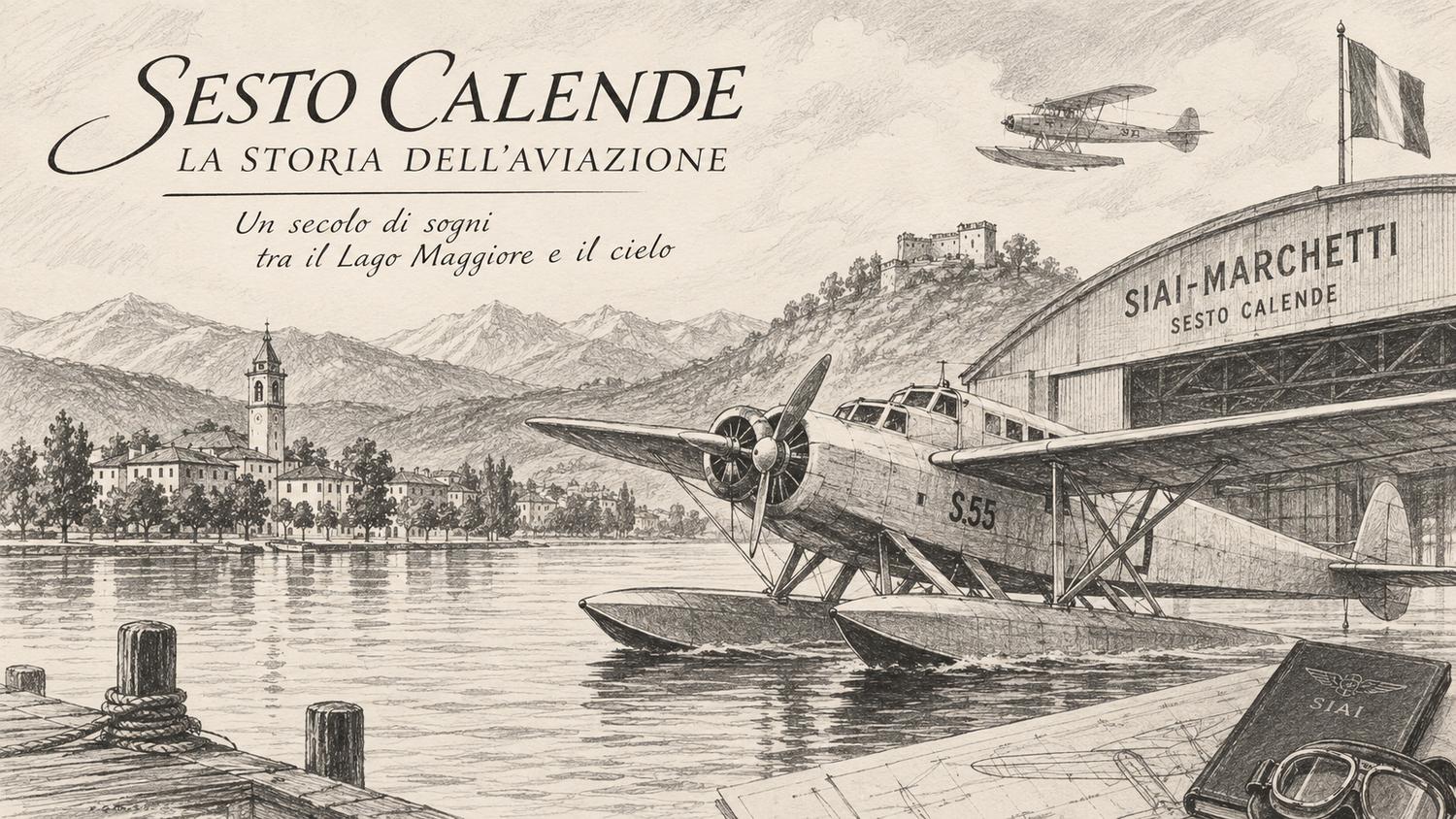
The history of aviation in Sesto Calende is closely linked to the waters of Lake Maggiore and to the birth, on its shores, of one of the most important names in the Italian aircraft industry.
A major turning point came in 1915, when the Società Idrovolanti Alta Italia (SIAI) was founded in Sesto Calende. The company would later become the renowned SIAI-Marchetti. At Sant'Anna, a seaplane base was established on the lake, where flight training and licensed production of seaplanes began. In 1917, the company produced its first original design, the S.8, created by engineer Raffaele Conflenti.
A fundamental moment came in 1922, when engineer Alessandro Marchetti joined the company. He would become one of the most important Italian aircraft designers of the 20th century. Under his direction, numerous innovative aircraft were developed in Sesto Calende, including the S.51 and, above all, the S.55, one of the most famous seaplanes in aviation history.
The 1920s and 1930s were a period of international fame. Aircraft built in Sesto Calende took part in competitions, set records and were used in major aviation expeditions. In 1920, Umberto Maddalena flew from the Sant'Anna seaplane base to Helsinki aboard a SIAI S.16. In 1925, Francesco De Pinedo and Ernesto Campanelli travelled approximately 55, 000 kilometres from Sant'Anna to Melbourne, Tokyo and Rome aboard the SIAI S.16 Gennariello.
Even more famous was the 1933 expedition, when a formation of 24 S.55X seaplanes, built in Sesto Calende, departed from Orbetello under the command of Italo Balbo for the famous transatlantic flight to North America. These achievements helped make both SIAI-Marchetti and Sesto Calende known throughout the world.
During the 1930s, production expanded from seaplanes to land-based aircraft. The SIAI-Marchetti factories produced some of Italy's most important aircraft of the period, including the S.79 Sparviero, while the nearby plant in Vergiate became increasingly important for production.
After the Second World War, the company went through a difficult period but gradually recovered. During the 1960s, new and highly successful aircraft were introduced, including the SF.260, which was produced and operated in many countries. In 1969, SIAI-Marchetti was acquired by Agusta, marking the beginning of a new chapter in the area's aviation history.
Sesto Calende's aviation tradition did not end with this transformation. The historic factories and sites associated with aircraft production have remained an important part of the local heritage, while the former Sant'Anna seaplane base is now part of Parco Europa, preserving the memory of an era when seaplanes took off directly from the waters of Lake Maggiore.
For this reason, Sesto Calende can rightly be considered one of the birthplaces of Italian aviation: a place where, more than a century ago, the lake became a runway and where designers, pilots and engineers helped write some of the most remarkable chapters in the history of Italian aviation.